A conventional stop-loss can close a forex position at a worse price than its trigger. A stop-limit adds a price restriction, but that restriction can leave the position open while losses grow. The choice changes which execution risk you accept: an uncertain fill price or the possibility of no fill.
The distinction matters most when a quote jumps across both your trigger and your preferred exit price. Before relying on an order, identify what activates it, what can execute afterward, and what happens to any quantity left unfilled. Order names and available features differ between providers; a platform offering a stop-loss does not necessarily offer a protective stop-limit.
Trigger price and execution price are separate
A stop price is the condition that activates an instruction. It is not necessarily the price at which a trade can be completed. In the conventional stop-market model used here, activation sends an instruction to close at available market prices. Execution remains subject to the provider’s rules, market availability and order acceptance; “market” does not promise a fill regardless of circumstances.
A stop-limit also has an activation condition. After activation, the limit controls acceptable execution prices. For a sell order, that means the limit price or higher. For a buy order, it means the limit price or lower. If no acceptable executable price is available, an active limit order can remain unfilled, subject to its validity and cancellation rules.
Do not infer these mechanics from the word “stop” alone. Read the ticket and contract, including whether the instruction closes an existing position, opens a new one, or uses a platform-specific price bound.
One hypothetical long position, two possible outcomes
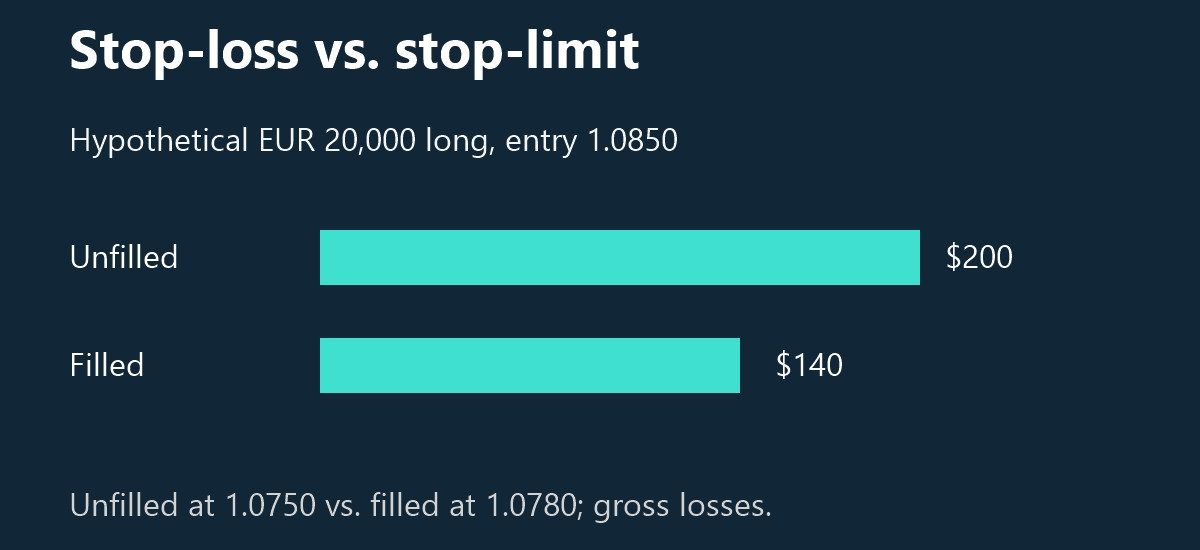
Assume a USD account holds a long position of EUR 20,000 bought at an actual fill of 1.0850 USD per EUR. The trader selects a sell trigger of 1.0800. In the stop-limit alternative, the sell limit is 1.0795. For this example, the trigger uses the bid, and the provider accepts this order configuration. These are teaching assumptions, not a trade recommendation or a description of every platform.
If the conventional stop executes at 1.0800, the gross loss is EUR 20,000 × (1.0800 − 1.0850) USD/EUR = −$100. If the quote gaps and the actual fill is 1.0780, the gross loss becomes −$140. The difference is $40, equivalent to 20 pips at $2 per pip for this position.
| Hypothetical path | Conventional stop-market | Sell stop-limit: trigger 1.0800, limit 1.0795 |
|---|---|---|
| Executable bid reaches 1.0800 with enough size | Can fill at 1.0800; actual execution must be checked | Once activated, 1.0800 satisfies the sell limit |
| First qualifying executable bid is 1.0780 | Illustrative fill at 1.0780 produces a $140 gross loss | 1.0780 is below the sell limit; no fill at that price |
| Bid then falls to 1.0750 without an acceptable fill | In the assumed filled case, the position is already closed | Position remains exposed; marking the full position at this bid gives a $200 unrealized gross loss |
| Price later returns to 1.0795 | No remaining position in the assumed filled case | A still-active order may execute if all conditions and available size permit |
The limit avoids selling below 1.0795 under the assumed rules. It does not cap the account loss at the $110 that a full fill at 1.0795 would realize. While the position remains open, its value continues to change. If only part fills, the remainder stays exposed unless the contract specifies another outcome.
These figures exclude commission, financing and account adjustments. Actual entry and exit fills already reflect the prices traded; do not deduct the same spread again. See the account-currency P&L guide when the result must be converted into another currency.
A chart touch is not an execution record
The chart may display bid, ask or midpoint, while the trigger uses a different quote or rule. A long position normally exits through a sell; a short position exits through a buy. Confirm the actual trigger convention rather than assuming the chart’s visible price is the required one.
Even a qualifying quote does not establish that enough quantity was available for the whole order. A candle’s high and low also do not establish the sequence of quotes within that interval. Keep the order’s trigger event separate from its fills and any remaining quantity. The spread guide explains how a changing bid–ask gap can affect a trigger.
For short positions, reverse the price restriction
Suppose a short position is protected by a buy stop-limit with a trigger of 1.0900 and a limit of 1.0905. After activation, buying at 1.0905 or lower satisfies the hypothetical limit. If the first available ask is 1.0920, that price is too high. The order may remain unfilled while the short position loses value as the market rises.
The $40 slippage calculation in the long example should not be copied blindly into a short trade. Use the actual position quantity, price difference, quote currency and fill direction. The sign of P&L reverses between buying first and selling first.
What to inspect before submitting an order
- Purpose and quantity: confirm that it closes the intended position and covers the intended size. Check how partial closes affect the attached order.
- Trigger: identify the quote side, activation level, trading session and any special conditions.
- After activation: determine whether the instruction becomes a market order, a limit order or another provider-defined instruction.
- Unfilled quantity: check expiration, partial fills, rejection handling and whether a residual order remains active.
- Amendments: verify the accepted order status after a change. A requested cancellation is not the same as a confirmed cancellation.
- Account constraints: review margin requirements and closeout rules independently. A pending limit does not suspend a provider’s account-level risk controls.
A demo account can help you understand the ticket and status labels. It does not establish that live execution will behave identically during a gap.
How to investigate an unexpected result
Save the position ID, order ID, original instruction, accepted amendments, timestamps and time zones. Ask for the provider’s trigger quote, execution prices, filled quantities and final order status. Then reconstruct three events: when the condition was met, what instruction became active, and which quantities actually traded.
For the example above, “the market passed 1.0800” is insufficient to explain a sale at 1.0780 or an unfilled limit. The former needs the execution record; the latter needs the limit, validity and available-price records. A quote from a different provider supplies context but does not prove what was executable for the disputed order.
Frequently asked questions
Is a guaranteed stop the same as a stop-limit?
No. Where offered, a guaranteed stop is a separate contractual feature intended to deliver its stated stop level subject to its terms. Check eligibility, fees, minimum distances and amendment restrictions. A stop-limit’s execution-price restriction does not guarantee closure.
Is a tighter stop-limit gap always safer?
No universal conclusion follows. A narrower acceptable price range can leave fewer prices at which an order can execute. A wider range permits less favorable fills. Neither setting removes the need to consider position size and continued exposure.
Should I cancel an unfilled stop-limit and send a market order?
That decision depends on the account and market situation. First establish whether cancellation has been confirmed and whether any quantity has already filled. Sending another closing instruction without checking the original can create an unintended order or position, depending on the platform’s netting and position rules.
Leveraged forex can cause rapid losses. Order instructions do not eliminate market, execution or margin risk. This guide explains mechanics and hypothetical arithmetic, not personalized trading advice. Read the Financial Risk Disclosure and the contract for your account.