A trade can make money on its entry and exit prices and still earn less than the profit shown before fees. If you held it across your provider’s daily cutoff, an overnight financing charge—often labelled swap, rollover or funding—may explain the difference.
To check the charge, use the rate for your trade direction, the quantity or value specified in the contract, and the financing days attached to each booking. Then convert into your account currency. A three-day booking can be legitimate even when you crossed only one cutoff.
The worked account below shows how a $3 ordinary debit becomes $9 at one rollover, why a changing rate alters the total, and how to avoid subtracting the same fee twice. All rates, trade sizes and conversions in the examples are hypothetical.
Start with the statement entry
Find the deal or position ID, instrument, direction, quantity, booking date and currency of the charge. Save the contract specification and the applicable financing schedule. A rate shown today may be indicative or may have replaced the rate used for an earlier booking. Reconcile against the finalized historical rate when the provider makes it available.
Do not use the cash posted as margin as the financing base unless the contract explicitly defines it that way. A leveraged position can have a much larger notional value than its margin requirement. Substituting margin for notional can make a calculation appear affordable while understating the actual cost.
Read the rate’s unit before choosing a formula
A number such as “−6” cannot tell you the cost on its own. It could mean cash, platform points or an annual percentage. Copy the unit from the instrument specification alongside the number.
| Schedule format | Inputs you need | Error to avoid |
|---|---|---|
| Annual percentage | Specified position base, rate, financing days and year denominator | Using posted margin as the calculation base |
| Cash per lot per financing day | Lots held, daily cash rate and financing days | Dividing an already daily rate by 365 |
| Platform points | Contract point size, contract size, volume and currency conversion | Assuming a point always equals a pip |
| Final cash amount for a booking | Booking currency and any required conversion | Applying a day multiplier already included |
For a separate hypothetical cash-rate contract quoting a $6 debit per lot per financing day, a 0.50-lot position with a three-day booking costs 0.50 × $6 × 3 = $9 before any separately specified adjustment. This reaches the same amount as the annual-rate example below using a different method. Do not combine both methods for one charge.
Use the long rate for a buy position and the short rate for a sell position. Confirm the sign convention too: a statement can display a debit as a positive number in a “charges” column.
A hypothetical annual-rate calculation
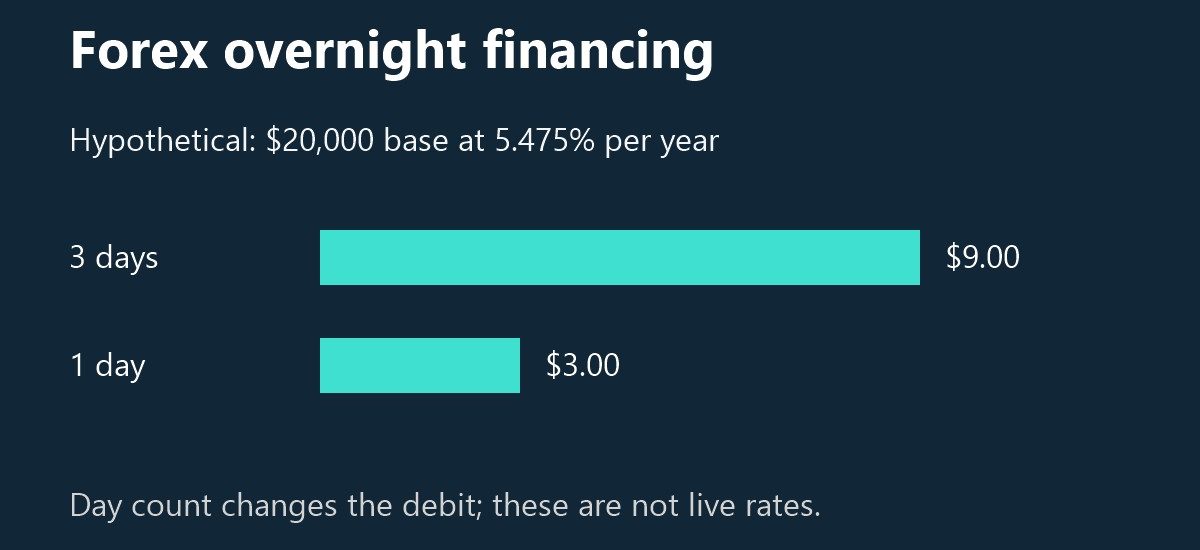
Assume an account’s contract defines financing as USD position value multiplied by an annual debit rate, multiplied by financing days, divided by 365. The example position value is $20,000 and the all-in annual debit rate is 5.475%. These are hypothetical teaching inputs, not a current broker quote. No additional markup or conversion applies in this example.
One financing day costs $20,000 × 0.05475 ÷ 365 = $3.00. A booking that represents three financing days costs $9.00.
| Booking | USD calculation base | Annual debit rate | Financing days | Debit |
|---|---|---|---|---|
| Ordinary rollover | $20,000 | 5.475% | 1 | $3.00 |
| Three-day rollover | $20,000 | 5.475% | 3 | $9.00 |
| Later one-day rollover | $20,000 | 6.570% | 1 | $3.60 |
The total of these three bookings is $15.60. The last row deliberately changes the rate. Multiplying the first daily charge by the total number of financing days would instead give $15.00 and miss the change. Calculate each booking using its own inputs, then add the results.
The formula applies only to the stated hypothetical contract. A provider may publish points, an amount per lot, or a rate using another denominator or valuation base. If the schedule gives a daily cash amount, dividing it by 365 again would be wrong. If its published amount already includes several financing days, multiplying by that day count again would also be wrong.
Why one booking may cover several days
Rollover can account for the movement of settlement dates over weekends and holidays. Under a common T+2 settlement convention, a Wednesday rollover may move settlement from Friday to Monday and therefore cover three days. That does not make Wednesday a universal triple-charge day for every pair, account or product. Check the provider’s instrument calendar and holiday adjustments.
A brief holding period that crosses the cutoff may incur financing under the account terms. Conversely, counting elapsed hours does not establish the charge. Record the provider’s cutoff time zone and the actual date; daylight-saving changes can alter the corresponding time in your location.
Translate the charge into the account currency
Suppose the illustrative $9.00 debit must be converted to a euro account at an assumed conversion of EUR 0.92 per USD. Before any separately specified conversion charge, the debit is €8.28. Multiplication is appropriate because the conversion quote is euros per dollar. With a quote expressed in dollars per euro, the calculation would use division.
Use the provider’s applicable conversion method and booking rate to reconcile a real statement. A current search-engine exchange rate may differ from the historical conversion used. See forex profit and loss in account currency for another example of checking currency units.
Reconcile the full trade result
Keep financing, commissions and the profit or loss from actual fills in separate worksheet columns until you establish what the platform’s reported total already contains. If a net result includes financing, subtracting the financing line again understates the result. If it excludes financing, the adjustment still needs to be included in the final reconciliation.
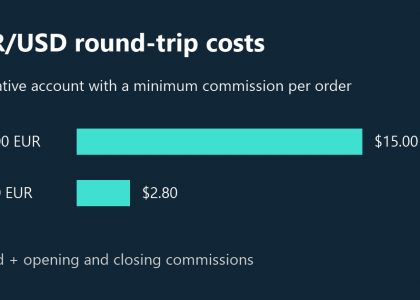
For a hypothetical $40 gross gain, $15.60 financing debit and $4.00 commission, the net is $20.40, assuming no other adjustments. This arithmetic says nothing about future profitability. A financing credit on a different position would not remove exposure to price losses, spread costs or conversion charges. The commission guide explains how opening and closing charges can differ.
When your calculation does not match the statement
Use the pattern of the difference to decide which input to inspect. An approximately threefold difference suggests checking the day multiplier; it does not prove that a charge is wrong. A small difference still needs to be traced to the actual rounding or conversion rules.
| What you observe | What to check first |
|---|---|
| A $9 booking instead of the $3 you expected | Whether it covers three financing days |
| A charge after holding for only a few minutes | Whether those minutes crossed the contractual cutoff |
| A smaller booking after a partial close | The quantity still open at the next cutoff |
| A debit where you expected a credit | Direction, sign convention and administration costs |
| A mismatch after conversion | Currency units, historical conversion rate and separate conversion charges |
| An apparently duplicated deduction | Whether the displayed P&L already includes financing |
In the hypothetical trade above, a platform that reports $20.40 net has already incorporated the assumed $15.60 financing and $4 commission. Subtracting those amounts again would incorrectly leave $0.80. A platform showing $40 gross needs both deductions once. The statement’s column definition determines which starting figure you have.
Retain calculation precision until the contract’s rounding step. Rounding each day before multiplying can differ from rounding a combined booking. If a discrepancy remains, request the rate, quantity, financing-day count and conversion used for the specific position ID.
A practical reconciliation checklist
- Match the legal entity, product and account type to the financing terms.
- Identify the position quantity and direction at each relevant cutoff, including partial closes.
- Retrieve the historical rate, its unit, and whether administration costs and day multipliers are already included.
- Check the instrument’s settlement and holiday calendar instead of assuming every booking represents one day.
- Apply the specified valuation base and currency conversion, recording rounding separately.
- Compare the calculated amount with the deal-level charge and statement total. Ask the provider to explain any remaining difference using the position ID and booking timestamp.
Frequently asked questions
Is an overnight financing credit guaranteed when one central bank has a higher policy rate?
No. Policy-rate differences alone do not specify the retail financing quote. Use the provider’s applicable directional rate and charges, and do not assume the long and short sides are equal and opposite.
Does closing before a cutoff guarantee a lower overall trading cost?
No. Reopening a position can introduce spread, commission and execution costs. Compare all applicable costs and exposure changes rather than treating avoided financing as a guaranteed saving.
Can I use today’s financing rate to project a month of costs?
It can support a clearly labelled scenario, but it does not lock the future rate, position value, currency conversion or calendar. Keep those assumptions visible and revise the estimate when they change.
Leveraged forex can cause rapid losses. This guide explains account arithmetic and is not a recommendation to open, retain or finance a position. Read the Financial Risk Disclosure and the terms for your account.