Suppose two forex accounts advertise commission of $3.50 per side and $7 per round turn. On one standard lot, the two prices can describe exactly the same $7 charge. But scale the trade down to a tenth of a lot, or close it in two separate orders, and the bill can change. To compare accounts, you need the charging unit, the minimum fee, the spread and the way your order will be executed.
Read the line beneath the headline price
A side is one leg of the trade. Buying to open is one side and selling to close is another. A round turn covers both legs for the same quantity. A rate advertised per standard lot also needs a contract definition. In the examples below, one standard lot is 100,000 units of the base currency. Check the specification on your own ticket, particularly if the platform displays contracts instead of units.
Record the fee currency as well. A dollar-denominated commission and a euro-denominated commission cannot be compared by doubling each number and picking the smaller one. Convert them into the same account currency using a stated rate. Also distinguish the pricing convention from the posting convention. If the provider collects a round-turn charge at entry, a single commission line can cover both legs. Read the fee description before adding a second charge to your estimate.
Work through one trade at two sizes
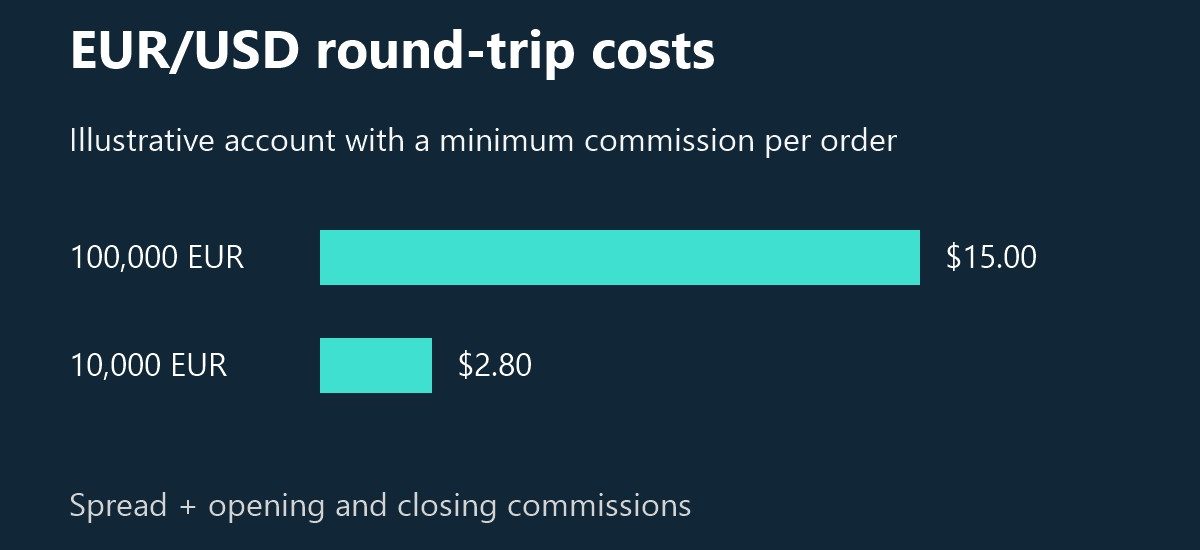
Assume a hypothetical EUR/USD account charges $3.50 per standard lot per side, subject to a $1 minimum per separately submitted order. The spread is 0.8 pip at both entry and exit. The midpoint stays constant and both orders fill at the displayed prices. There is no financing charge. These assumptions isolate spread and commission so that you can check the arithmetic.
| Position | Dollar value of one pip | Spread cost | Commission for opening and closing | Total |
|---|---|---|---|---|
| EUR 100,000 | $10 | $8.00 | $3.50 + $3.50 | $15.00 |
| EUR 10,000 | $1 | $0.80 | $1.00 + $1.00 | $2.80 |
On the smaller trade the proportional fee is only $0.35 per side, so the $1 floor applies twice. Scaling the large trade’s $15 cost by one tenth would give $1.50, understating the illustrative bill by $1.30. The cash cost falls as the trade gets smaller, while the cost expressed in pips rises from 1.5 to 2.8.
To find where the minimum stops applying, divide the minimum by the per-lot charge. Here, $1 divided by $3.50 is about 0.286 standard lot per order. Check the platform’s quantity increments and rounding rules near that threshold.
Compare a commission account with a spread-only account
Suppose a second account quotes a 2-pip spread with no separate commission. Under the same unchanged-midpoint assumptions, its round-trip cost is $20 on EUR 100,000 and $2 on EUR 10,000. The first account costs $5 less on the larger position but $0.80 more on the smaller one. The order minimum changes which account is cheaper for that scenario.
You can calculate the break-even spread before comparing quotes. Divide the first account’s total round-trip commission by the position’s pip value and add its spread. For EUR 10,000, the result is 2 commission pips plus 0.8 spread pip. A comparable spread-only quote below 2.8 pips would cost less under these assumptions. Use observations from the same currency pair and trading window. A minimum spread from one fee sheet and an average spread from another describe different conditions.
What if you close in two pieces?
Consider the EUR 10,000 position again. Opening it in one order triggers one $1 minimum. Closing EUR 5,000 now and EUR 5,000 later in two separate orders triggers two more $1 minimums under the example schedule. Total commission becomes $3. If spreads and prices are otherwise unchanged, the spread cost on the combined quantity remains $0.80. The extra dollar comes from the additional chargeable order.
A single order that receives multiple execution fills is a different case. The number of lines on a fill report tells you how many executions occurred. Whether each attracts a minimum depends on what the provider calls a chargeable order. Check the schedule and match fees to order IDs before treating each fill as a new order.
When the rate is quoted in basis points
One basis point is 0.01 percent. A hypothetical rate of 0.20 basis point is therefore a decimal multiplier of 0.00002. Applied to $110,000 of chargeable value, it produces $2.20 for that side before any minimum. Applied to $11,000, it produces $0.22. If the hypothetical minimum is $2 per order, the smaller trade incurs $2. Repeat the calculation using the closing order’s actual chargeable value, which can differ from the opening value.
Make sure the figure you multiply is the trade value specified by the provider. The cash posted as margin can be much smaller. Using margin as the commission base can understate an estimate even if you converted the basis-point rate correctly.
Reconcile the estimate against a statement
- Match the instrument, legal entity, account type, fee tier and trade date to the applicable fee schedule. Save the version you used.
- List each opening and closing order, its executed quantity, the charging currency and any minimum. Separate order IDs from individual fills.
- Recalculate explicit commission and compare it with the statement. Check currency conversion, rounding, volume tiers and whether the opening entry covered both sides.
- Calculate trading P&L from actual fills. The buy and sell prices already reflect the spread. Deducting an estimated spread again would double count it. Reconcile separate commission and financing entries according to the statement’s definition of net P&L.
For the fill-price calculation, see how to convert forex profit and loss into your account currency. For an unexpected change in execution cost during a release, see why forex spreads widen around major news.
Does closing at my entry price guarantee that I break even?
If the actual entry and exit fills are identical, price P&L is zero before separate charges. A commission can still leave a net loss. If only the chart midpoint returned to its starting level, check the executable bid and ask as well.
Can I use this calculation for an overnight position?
Use it for the spread and commission components, then reconcile financing separately using the applicable product terms and holding period. Leverage can magnify losses relative to the amount deposited. See the Financial Risk Disclosure.