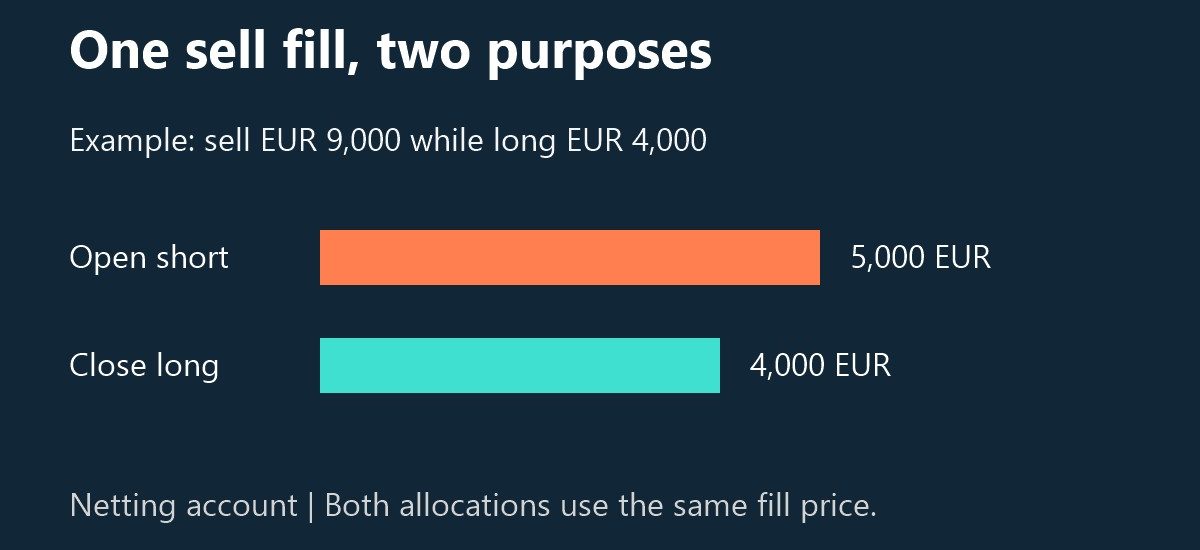
Suppose you are long EUR 10,000 and sell EUR 15,000. On a netting account, a complete fill leaves you short EUR 5,000. To check the money on your statement, find the fill where the old long runs out. Units sold up to that point close the long. Units sold beyond it establish the entry price of the new short. When the sale executes at two prices, the distinction can change the realized result even if your final position size is correct.
Follow the quantity through zero
Consider a hypothetical USD account with a single EUR/USD long of EUR 10,000 bought at 1.1000 dollars per euro. The account nets trades in the same pair into one position. A sell order for EUR 15,000 fills in two parts, first EUR 6,000 at 1.1020 and then EUR 9,000 at 1.1010. All prices are assumed fills. The calculation initially excludes commission and financing.
| Execution | Old long closed | Gross profit booked | Position after fill |
|---|---|---|---|
| Sell 6,000 at 1.1020 | EUR 6,000 | +$12 | Long EUR 4,000 |
| Sell 9,000 at 1.1010 | EUR 4,000 | +$4 | Short EUR 5,000 |
The first sale realizes 6,000 × (1.1020 − 1.1000) = $12. Of the second sale, only EUR 4,000 can close an existing long. Those units realize another $4. The remaining EUR 5,000 opens the short at 1.1010. The old long has now earned $16 gross, and the new short has its own entry price. The two allocations within the second fill can be reconstructed on a worksheet even if the platform displays one deal row.
Why the average sell price can put profit on the wrong trade
Across the whole sell order, the weighted average is (6,000 × 1.1020 + 9,000 × 1.1010) ÷ 15,000 = 1.1014. That figure accurately summarizes all the euros sold. Using it as the closing price for the original EUR 10,000 would show a $14 realized gain. Using it again as the new short entry would start that position four pips above its actual entry.
The error can hide in the account total. Assume the short is later bought back in full at 1.1030. Its loss is 5,000 × (1.1010 − 1.1030) = −$10. The sequence earns $16 − $10 = $6 gross. The incorrect allocation also gives $6, made up of a $14 gain and an $8 loss. Matching the final total alone would miss the $2 assigned to the wrong position. Compare the realized amount immediately after the reversal as well as the basis of the remaining exposure.
An independent arithmetic check is possible once the example is flat. The two sales amount to $16,521. The original purchase and final repurchase amount to $11,000 + $5,515 = $16,515. The difference is $6. These amounts represent trade values for the calculation. A margin account may show only the resulting P&L and charges in its cash history.
Check what actually filled before sending another instruction
If the second fill never happens, the example account remains long EUR 4,000. If only another EUR 4,000 sells, the account is flat. If the entire second fill completes, it is short EUR 5,000. All three outcomes begin with the same requested sell quantity. Before amending or replacing an order, inspect its filled volume, any live remainder and the current position on the same account. A pending remainder could still execute after you take a screenshot.
Account mode also matters. MetaTrader 5 supports both netting and hedging. In hedging mode, a fresh sell instruction can open a separate short alongside the long. A screen could then show a EUR 10,000 long and a EUR 15,000 short with the same net directional quantity as the worked example. The open tickets and realized P&L would tell a different story. Look for the position identifiers and how the order was submitted before applying a netting worksheet.
Rebuild the statement in execution order
- Export the opening deals and the reversal order’s completed deals. Include earlier history if the original entry falls outside the reporting period. Record the instrument, account mode, account currency, quantities and timestamps.
- Start with the signed position immediately before each execution. For an opposite-side fill, the closing quantity is the smaller of the absolute open quantity and the executed quantity. Any excess starts the opposite position at that fill price.
- Recalculate realized P&L using the account’s basis for the units closed. The single-entry example has one known cost basis. With several entries, check the account’s matching rules and trade history.
- Reconcile the exposure still open. Record its side, quantity and entry basis before adding a valuation price and timestamp for any unrealized result.
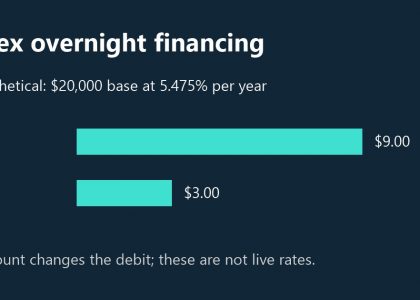
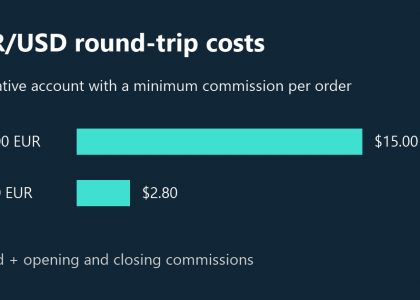
- Check actual charges against the statement. If all commissions and financing across the completed example total $4, the $6 gross result leaves $2 net. A platform can show a single fee for the second deal even though your worksheet divides its units into closing and opening portions. Count that fee once.
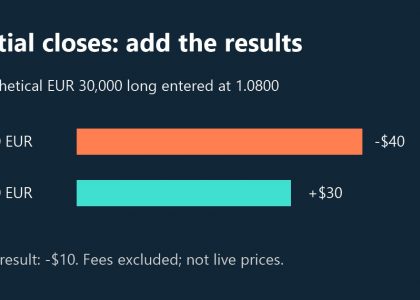
For the arithmetic when an exit leaves units on the original side, see partial forex closes. For a statement denominated in another currency, use the booking currency and applicable conversion rate for each amount. The account-currency P&L guide walks through that conversion.
Frequently asked questions
Why does the statement show one 9,000-unit sale when only 4,000 units remained long?
An execution record describes the quantity sold. On the assumed netting account, the position before the deal determines how much closes and how much establishes new exposure. Check the balance of units immediately before and after that deal.
Does a reversal always produce an instant profit or loss on the whole sell order?
The closing units realize the result on the old position. The newly opened units have ongoing price exposure. Spread, marking conventions and transaction charges can affect the account as soon as the new position appears.
Which records should I request if the figures disagree?
Request the order ID, deal sequence, executed quantities and prices, linked position history, cost basis and itemized charges. If commissions appear in a different currency, request the applied conversion rate. Those records let you isolate a volume difference, a price allocation difference or a fee discrepancy.
Leveraged forex can produce rapid losses. A reversal creates exposure in the opposite direction, and pending orders may change that exposure again. Read the Financial Risk Disclosure and the execution terms for your account.