Closing part of a forex position realizes profit or loss only on the quantity actually closed. The remaining quantity continues to gain or lose value. A profitable first exit therefore does not establish the final result of the trade, and averaging exit prices without weighting their sizes can give the wrong answer.
This guide follows one hypothetical position through two exits. It shows how to separate realized from unrealized P&L, calculate the correct average exit, and reconcile charges without counting them twice. The figures are examples, not live prices or a recommendation to scale out of a trade.
Begin with executed quantities, not the requested order
An order is an instruction; its execution may produce one or more deals. A position is the exposure that those transactions leave open. Use the completed deal quantities and prices from the account history, linked to the relevant position. A request to close 10,000 units is not proof that all 10,000 units closed.
Record the instrument, direction, entry fills, each closing fill, position identifier, account currency and charges. If a closing instruction is only partly filled, identify both the open position quantity and any outstanding order. They are different records: exposure can remain even when the closing order has expired or been cancelled.
Worked example: close 10,000 euros, keep 20,000 open
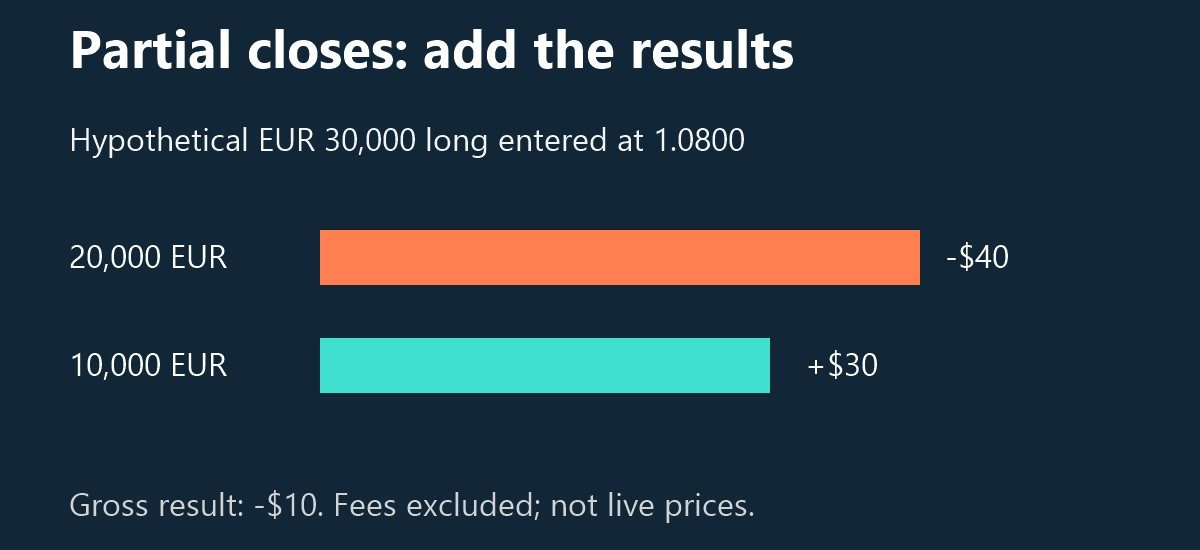
Assume a USD account bought EUR 30,000 at an actual EUR/USD fill of 1.0800. There are no additional entries. First, EUR 10,000 is sold at an actual fill of 1.0830. The remaining EUR 20,000 is later sold at 1.0780. Prices are dollars per euro; the calculations initially exclude all fees and financing.
For this long position, each realized result is quantity closed × (exit price − entry price). Multiplying euros by dollars per euro leaves a result in dollars.
| Event | Quantity closed | Actual exit | Realized gross P&L | Quantity still open |
|---|---|---|---|---|
| First exit | EUR 10,000 | 1.0830 | +$30 | EUR 20,000 |
| Final exit | EUR 20,000 | 1.0780 | −$40 | EUR 0 |
| Complete position | EUR 30,000 | Weighted exit 1.0796667, rounded | −$10 | EUR 0 |
The first calculation is 10,000 × (1.0830 − 1.0800) = $30. The second is 20,000 × (1.0780 − 1.0800) = −$40. Together they produce a $10 gross loss. A profitable first exit has not made the whole trade profitable because the larger remaining quantity subsequently lost more.
These are results from actual assumed fills. Do not subtract an additional spread estimate from the same fill-price calculation. For a non-USD account, see the account-currency P&L guide before combining amounts in different currencies.
Why a simple average of the two exit prices fails
The correct average exit is weighted by the quantity executed at each price:
(10,000 × 1.0830 + 20,000 × 1.0780) ÷ 30,000 = 1.0796666667 USD per EUR.
Using full precision, 30,000 × (1.0796666667 − 1.0800) gives approximately −$10. Keep the unrounded result in the worksheet; the extra digits here explain the arithmetic rather than represent an executable quote.
A simple average gives (1.0830 + 1.0780) ÷ 2 = 1.0805. Applying that average to all EUR 30,000 incorrectly suggests a $15 gain. The $25 error comes from giving the smaller, more favorable exit the same weight as the larger exit.
For this completed, single-entry example, summing the dollar results of each closing fill is the clearest cross-check. An average price is a summary, not a substitute for the underlying fills.
What the account can show between the exits
Immediately after the first exit, suppose the remaining position is marked at a bid of 1.0830. Its unrealized gross gain is 20,000 × (1.0830 − 1.0800) = $60. The account then has $30 realized and $60 unrealized from this position: $90 combined before charges.
If that bid subsequently falls to 1.0780, the open portion shows a $40 unrealized loss. The earlier $30 realized gain remains, so the combined result becomes −$10. The final exit at that same assumed price turns the remaining unrealized loss into realized loss without changing the combined gross result at that instant.
| Snapshot | Realized gross P&L | Unrealized gross P&L | Combined gross result |
|---|---|---|---|
| After first exit, mark 1.0830 | +$30 | +$60 | +$90 |
| Before final exit, mark 1.0780 | +$30 | −$40 | −$10 |
| After final exit at 1.0780 | −$10 | $0 | −$10 |
The valuation assumptions matter. A platform may use its own marking convention and incorporate separate adjustments. Compare figures taken at the same timestamp; a changing quote can explain why two screenshots do not reconcile.
Closing a portion reduces exposure but leaves risk
At EUR 20,000, a 0.0001 USD-per-EUR price change represents $2 of gross P&L. Before the partial close, EUR 30,000 had $3 of gross P&L per pip. The position has become less sensitive to the same price movement, but it has not become risk-free.
Check the quantity and validity of any remaining protective orders after reducing the position. Do not assume a stop or take-profit instruction has automatically changed exactly as intended. A later gap can still change the fill price or prevent a restricted order from filling. The stop-loss versus stop-limit guide explains that distinction.
Netting and hedging can change what a sell instruction does
In MetaTrader 5, the broker-selected account mode matters. Under netting, an opposite-direction transaction can reduce, close or reverse the single position for that symbol. Under hedging, opening a new opposite position can leave the original position in place; use the intended position-closing action and confirm its result.
Do not assume two opposite tickets mean the original trade was partially closed. Inspect position IDs and completed closing deals. Likewise, if you add a new entry between exits, the simple single-entry example no longer describes the entire sequence. Follow the account’s position accounting and matching rules, and reconcile each affected entry and close rather than applying one global average indiscriminately.
Deduct costs once, using the actual statement
Suppose the completed example also has a $3 opening commission, $1 commission on the first close, $2 on the final close and $1.50 total financing debit. The gross result is −$10. After the $7.50 of assumed charges, the net result is −$17.50.
Some reports show those costs separately; another screen may already include them in net P&L. Subtracting them again from −$17.50 would incorrectly produce −$25. Match the report’s definition before adjusting its result. Do not assume commission is proportional when an account applies minimum fees per order; consult the commission guide.
A practical reconciliation sequence
- Export the executed deals for the position, including activity before the report’s start date if the entry was earlier.
- Check that total quantity closed does not exceed the relevant open quantity unless a reversal or another position explains the difference.
- Calculate each closing result using its actual fill and applicable entry basis.
- Keep any remaining unrealized result in a separate column with a timestamp and marking price.
- Add statement commissions, financing and conversions exactly once, using consistent currencies.
- Compare the result with the platform’s position summary. For a mismatch, request the matching method, missing fills or charge allocation using the position and deal IDs.
Frequently asked questions
Does taking some profit guarantee the rest of the trade cannot lose overall?
No. In the example, the remaining position loses $40 after $30 was realized. The complete trade loses $10 before costs. The result depends on what happens to the remaining exposure and the charges incurred.
Can I average the pip gains from different exits?
Only a quantity-weighted calculation reflects unequal exit sizes. Here the exits are +30 and −20 pips. Their simple average is misleading; the larger losing exit must receive its proper weight. Dollar P&L per fill is usually easier to reconcile.
What changes for a short position?
For the same single-entry structure, gross P&L is quantity closed × (entry sell price − exit buy price). Use the actual buying-back fills and check the remaining short quantity. Fees and account-currency conversion still require separate reconciliation.
Leveraged forex can cause rapid losses. Partial closes change exposure but do not guarantee profit or execution. This guide provides hypothetical accounting examples, not personalized investment advice. Read the Financial Risk Disclosure and the terms for your account.